About halfway through a session last spring, a member described a problem that had no clean answer. Staff across the organization were getting real clinical and financial value from AI. Much of that use was happening on personal accounts, because the sanctioned enterprise tool was too locked down to be useful. Security could block the traffic, but blocking it meant taking away something that was genuinely helping people do their jobs.
Within a minute, three other people from three very different organizations said some version of “we are living the same thing.” Nobody had a complete answer yet. Everyone had the problem.
That moment is why we run AI roundtables.
How the roundtables work
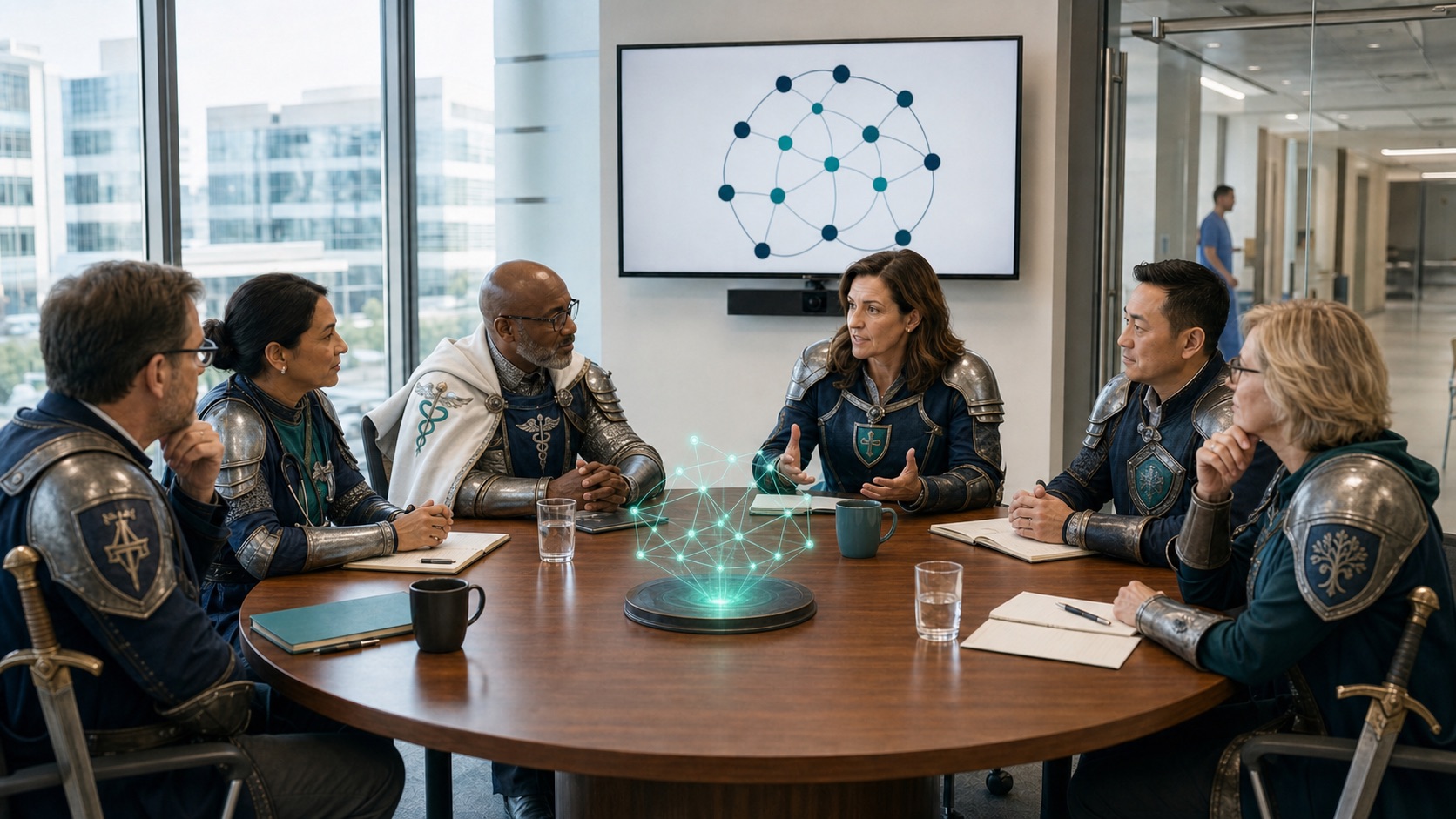
For the past year, Henecorp has facilitated multiple recurring peer roundtables for healthcare IT and AI leaders, meeting on biweekly and monthly cadences. Members come from health systems, healthcare AI companies, consulting firms, and clinical practice, and their day jobs span data science, informatics, cybersecurity, application leadership, and the executive suite.
The format is deliberately simple. Small groups, so everyone gets airtime. No slides and no pitches. A loose agenda that follows what people are actually wrestling with that week. And one hard rule: nothing leaves the room with a name attached. That rule is what makes the conversations honest. People tell each other things they would never say on a conference panel or in front of a vendor.
Behind the scenes we add one discipline that turns good conversation into intelligence: every session gets recapped, and we track recurring themes across all of them. When the same problem shows up session after session, in separate groups whose members have never met each other, that repetition is the industry telling you where its real gaps are.
Twenty-four sessions in, five gaps keep coming back.
1. Governance holds up on paper and struggles on contact
Nearly every organization at the table has an AI committee, an intake process, and a policy document. Governance is still the single most discussed topic across every group, because the gap between the policy and daily behavior stays wide.
The opening story is the canonical example. When the sanctioned tool is too restricted to help, people route around it, and they route around it because the unsanctioned tools work. An answer we have now heard from multiple organizations is to stop fighting that current and redirect it. Some build a branded internal interface on enterprise-hosted frontier models, so the shadow use moves inside the firewall under a business associate agreement. Others purchase a platform like BastionGPT, which gives staff HIPAA-compliant access to the top models without an internal build. Either way, people get the real tools safely. That need is exactly why Henecorp partners with BastionGPT to provide this type of solution.
A counterintuitive insight also emerged from the rooms: intake friction has value. A review process that requires a named owner, an intended use, and a penalty-for-failure assessment filters out the ideas nobody is actually willing to own. The organizations struggling most are the ones where governance is either so heavy it drives shadow adoption or so light it approves everything.
2. Nobody has solved training, so learning stays personal
Put a room of senior healthcare technology leaders together and ask how they learned AI. The answer, almost universally: most are self-taught, through YouTube, experimentation, and each other. Some have sought out independent courses and one-off workshops on their own initiative, and some have had their organizations invest in advanced training for them. Real experts sit at these tables. Their expertise is almost always the product of a personal effort.
What we have yet to hear anyone describe is organization-wide training that works. The programs that do exist tend to underperform. Generic “how AI works” sessions fall flat. What works, according to the people who have tried both, is role-specific and use-case-driven teaching with clear guardrails, delivered to a small target group and measured on results.
The larger pattern is that deployment keeps outrunning readiness. Organizations roll out tools, then discover their people were never prepared to use them well. We wrote about this gap in more depth in our piece on healthcare AI literacy.
3. The build-versus-buy math has inverted, and the vendor stack keeps growing
A narrative we have heard in many forms, from many organizations: a small internal team builds a tool on a foundation model API for a few hundred dollars a month in usage costs, doing roughly what a vendor quoted at tens of thousands annually. Health systems that never considered building software are now weighing it seriously.
At the same time, every enterprise platform these organizations already own is shipping its own AI. Members describe weeks with several vendor meetings, each pitching essentially the same agent-building product. The emerging executive posture is to shrink the technology stack instead of adding to it, and the EHR vendors turning themselves into AI platforms are accelerating that consolidation. The decision is now three-way: build it, buy it, or enable it through a platform you already own. We laid out that framework in Build AI, Buy AI, or Enable AI.
4. Model validation has no clear owner
The cautionary tales that resurface most often involve clinical prediction models deployed without a proper evaluation period: models that went live without the recommended silent-run phase, surfaced features the clinical teams disagreed with, and may have moved outcomes in the wrong direction. Just as often, members describe evaluating a model in the same class and declining to deploy at all, and the declines look like wisdom in hindsight.
Out of those stories, the group keeps re-deriving the same fundamentals: judge a model by its penalty for failure, distrust any single accuracy metric, let a model run silently for months before acting on it, and schedule drift reviews after go-live.
The unresolved question is structural. Who owns validation: the vendor who built the model, the health system deploying it, or a third party? A year of conversations has produced good practices and no industry answer.
5. The workforce question has turned personal
Early sessions treated AI and jobs as an abstract policy topic. A year later the conversation is in the first person. “My job is now reading and editing.” Senior people worry about skill atrophy when the model does the easy half of the work. Nearly everyone worries about how the next generation builds judgment when they start their careers with AI in hand.
The consensus that has emerged is more grounded than either the doom or the utopia narrative. In the real cases members bring to the table, AI makes a person faster and more accurate at the same job, and its bigger labor-market effect is slower hiring. The savings organizations can actually point to come from process improvements in areas like billing, fraud detection, and software spend.
Why the format works
None of these five gaps surfaces at a vendor keynote, and only fragments surface on webinars and panels. They surface when practitioners talk to each other candidly, with no stage and no sales agenda.
The cross-organizational mix does real work here. When a county health system, an academic medical center, and a startup founder compare notes and discover they are solving the same problem in different clothing, everyone leaves with sharper pattern recognition than any one organization could develop alone. And the connections outlast the sessions. Members have found collaborators, validators for their models, and honest answers to questions their own organization had no one to ask.
The honest part
We facilitate these groups, and we get as much out of them as anyone at the table. Several of the frameworks we have published, including the build-buy-enable model and much of our thinking on literacy and governance, started as roundtable threads. Twenty-four sessions of listening to the people doing the work keeps our advisory practice calibrated to what is actually happening inside health systems.
Frequently asked questions
What is an AI roundtable?
A small, facilitated peer group that meets on a recurring schedule to talk through how AI is actually showing up in members’ work. There are no presentations and no pitches. Members bring what they are trying, what is working, and where they are stuck, and the group works through it together.
Who attends?
Healthcare IT and AI leaders from health systems, healthcare AI companies, consulting firms, and clinical practice. Roles range from data science and informatics to cybersecurity, application leadership, and the executive suite. The mix is deliberate, because the best answers usually come from someone sitting in a different chair.
Do I need to be an AI expert to participate?
No. Every group includes people at very different depths, and the format is built so that a beginner’s question and an expert’s war story are equally welcome. The people who feel behind often get the most out of it.
Is the conversation confidential?
Yes. The hard rule is that nothing leaves the room with a name attached. Session recaps and theme tracking are fully anonymized, and this article follows the same rule.
How often do groups meet, and how long are sessions?
Biweekly or monthly, depending on the group, with sessions running 60 to 90 minutes. Groups stay small, typically 6 to 12 people, so everyone gets airtime.
Can Henecorp run a roundtable inside my organization?
Yes. Alongside the cross-organization peer groups, we facilitate internal roundtables that help a team learn AI together, share what is working, and build confidence one session at a time.
Join the conversation
We facilitate AI roundtables for organizations and peer networks that want the same thing for their own teams. If that sounds useful, schedule a conversation.